

 Jinba Flow
 Jinba App
 Jinba Toolbox
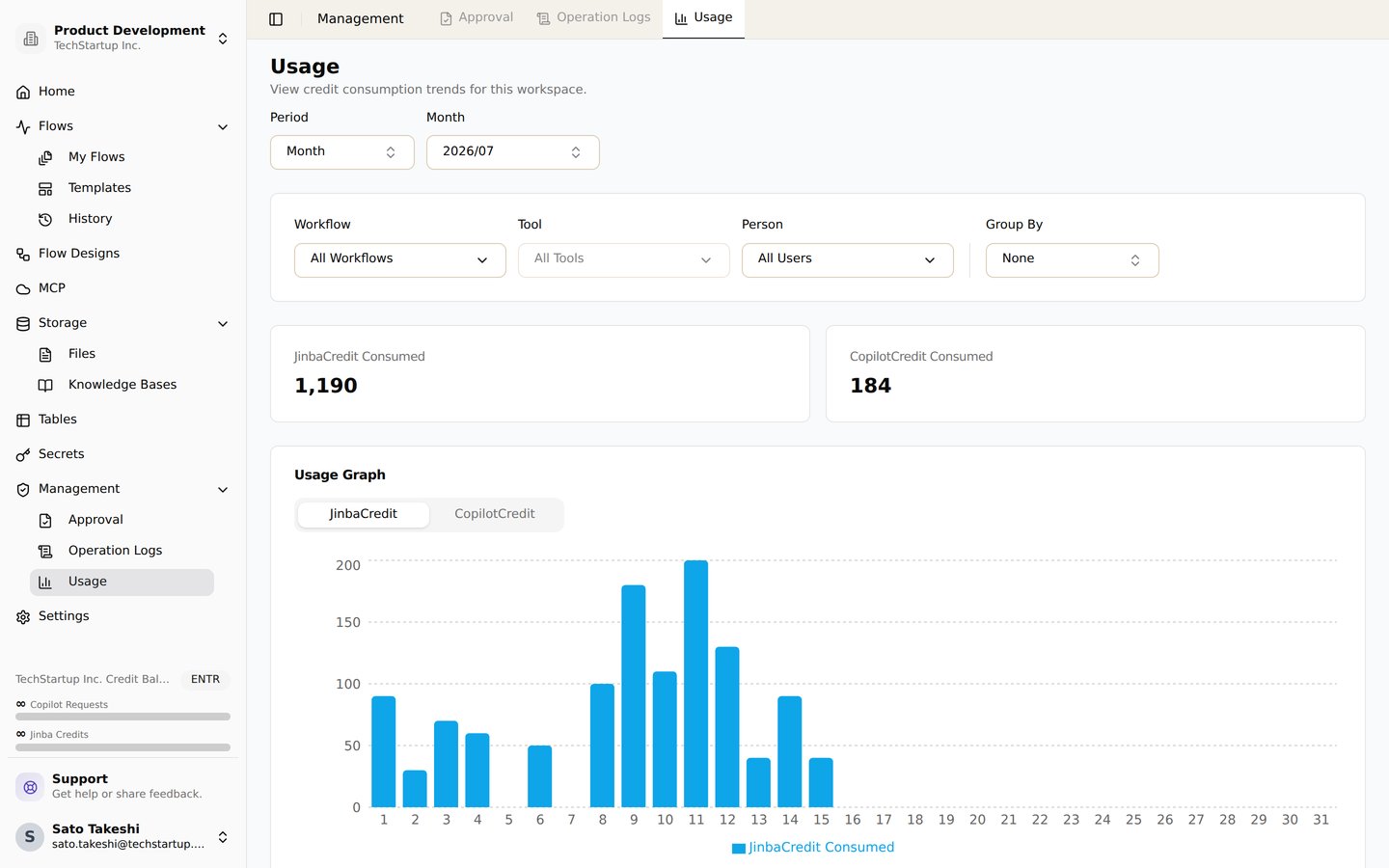
The usage page. Track Jinba Credit and Copilot Credit consumption by workflow, tool, and user
Overview
Jinba Flow uses two types of credits: Jinba Credits and Copilot Credits. Each credit type serves different purposes and has different reset periods.Note: Credits and subscription tiers are managed at the organization level. All members of an organization share the same subscription plan and pooled credits.
At a Glance
- Some tools consume Jinba Credits when you run them.
- For tools that support it, you can bring your own API key to skip Jinba Credit consumption.
- The required credits for Jinba-enabled tools are shown as a badge on the tool configuration page.
Credit Types
Jinba Credits
Jinba Credits are used for executing tools in workflows. They allow you to use Jinba’s API keys without needing your own credentials. Credits are pooled per organization.- Reset Period: Monthly (resets on subscription renewal or every 30 days for enterprise users)
- Usage: Deducted when running workflow tools like AI models, search APIs, and data processing services
- Cost Variation: Tools are priced in one of three ways — a flat cost per run, per-token metering, or a price computed from the media the run produces
- Custom API Key Bypass: You can provide your own API keys to bypass credit charges for certain tools
- Subscription Limits:
- Free: 1,000 credits/month
- Standard: 8,000 credits/month
- Professional: 100,000 credits/month
- Enterprise: Unlimited
Copilot Credits
Copilot Credits are used for AI assistance features and copilot functionality, such as generating step descriptions, summaries, and metadata. Credits are pooled per organization.- Reset Period: Daily (resets every day at midnight)
- Usage: Deducted when using copilot features (1 credit per request)
- Cost: 1 credit per copilot request
- Subscription Limits:
- Free: 100 credits/day
- Standard: 300 credits/day
- Professional: 500 credits/day
- Enterprise: Unlimited
Jinba Credit Cost Structure
Tools are priced in one of three ways: per token for the LLM tools, per unit of media produced for image and video generation, and a flat cost per run for everything else. The credits a tool requires are shown as a badge on its configuration page.Per-Token Pricing (LLM Tools)
These tools are billed from the tokens a run actually uses:- OPENAI_INVOKE / OPENAI_INVOKE_WITH_FILE
- ANTHROPIC_INVOKE / ANTHROPIC_INVOKE_WITH_FILE
- GEMINI_INVOKE / GEMINI_INVOKE_WITH_FILE / GEMINI_INVOKE_WITH_IMAGE
- GROK_CHAT
- OPENAI_DEEP_RESEARCH
- WORD_TEMPLATE_GENERATE
- TRANSLATE_PPTX_FILE
- LLAMA_CLOUD_QUERY
- ANTHROPIC_AGENT
- BROWSER_USE_SANDBOX_RUN_TASK
- The cost is calculated from the model you select and the tokens the run reports — input, output, and, on models that support prompt caching, cached reads and cache writes at their own rates. With web search enabled, each search the provider runs is added at its published per-search price (OpenAI and Anthropic 14 per 1,000 queries, Gemini 2.5 $35 per 1,000 grounded prompts), with the same markup.
- Before the step runs, a reservation is held against your balance, so a run cannot start unless you can cover it. When the step finishes, the reservation is replaced by the real cost, which is usually lower.
- Each tool has a fallback charge. It is the least a step settles at when a run reports no token usage at all, or when the model it ran has no published rate. It is also a lower bound on the reservation in step 2 — several tools hold considerably more than their fallback before they start, so read the reservation table below, not this one, to know what balance a run needs.
A run that does report tokens on a priced model settles at its actual token
cost, with no floor applied — usually well below the fallback. A short
GEMINI_INVOKE on gemini-flash-latest at roughly 1,500 input and 750 output
tokens settles at 1 credit, not 20. Long contexts, long answers and
multi-step agent runs cost proportionally more, and can run well above the
fallback.
What a run holds before it starts
Several tools can consume far more than their fallback, so they reserve a realistic — or worst-case — figure up front rather than the fallback. This is the balance the run needs to start; the reservation is released and replaced by the actual token cost when the step finishes, which is normally much lower.
Every other tool in the table above reserves close to its fallback.
A run that cannot cover its reservation fails to start with an
insufficient-credits error, even when the work itself would have cost far
less than the amount held.
Media Generation Pricing
These tools produce no tokens, so they are priced from what they generate. The cost is fully determined by the step’s settings, which means you can work it out before you run it. OPENAI_SORA2 is billed per second of video, at a rate set by the model and the output resolution:
GEMINI_GENERATE_IMAGE is billed per image generated:
A step keeps running on the model it names until Google shuts that model
down, and is charged at that model’s rate. Once the model is retired, the
step runs on its successor and is charged the successor’s rate instead — so
gemini-2.5-flash-image is 63 credits today and 108 from 2026-10-02.
New steps default to gemini-3.1-flash-image.
If a cost-driving setting (a model, a duration, a resolution) is filled in
by an expression such as
{{ steps.plan.output.model }}, the reservation
assumes the most expensive option it could resolve to, because the value is
not known until the step runs. The final charge is the price of what
actually ran.Usage-Based Search
These tools are charged for what the provider bills for each call, with the same markup as LLM tools (can use your own API key):- PERPLEXITY_SEARCH - Tokens at the selected Sonar model’s rate plus Perplexity’s per-request fee; Sonar Deep Research also bills its searches, citation and reasoning tokens. A short
sonaranswer is about 9 credits; a deep-research run is typically several hundred - EXAAI_SEARCH - Priced by search type, number of results and contents (text, highlights). The default search (auto, 10 results, text) is 28 credits; 100 deep-reasoning results with text and highlights is 488
1 Credit Per Use
These tools consume 1 credit each time they are executed:- PYTHON_SANDBOX_RUN - Execute Python code in a secure sandbox (always requires credits)
10 Credits Per Use
These tools consume 10 credits each time they are executed:- SERPAPI_SEARCH - Search using SerpAPI (can use your own API key)
- FIRECRAWL_SCRAPE - Scrape web content using Firecrawl (can use your own API key)
- ARXIV_INVOKE_AGENT - Access research papers from arXiv (always requires credits)
- YOUTUBE_GET_TRANSCRIPT - Extract transcripts from YouTube videos (always requires credits)
20 Credits Per Use
These tools consume 20 credits each time they are executed:- LLAMA_CLOUD_PARSE - Parse documents with LlamaCloud (can use your own API key)
Jinba Modules
These run on Jinba’s model keys and are charged per run:- JINBA_MODULES_PARSE - 88 credits
- JINBA_MODULES_EXTRACT - 40 credits
- JINBA_MODULES_CHECKER_V2, CHECKER_CHECK_BY_JSON, CHECKLIST - 58 credits
100 Credits Per Use
These tools consume 100 credits each time they are executed:- JINBA_FLEX_PARSER - Flexible document parsing (can use your own API key)
Copilot Credit Usage
Copilot Credits are consumed when using AI assistance features:- Step Description Generation: 1 credit per request
- Flow Summary Generation: 1 credit per request
- Metadata Generation: 1 credit per request
- Cron Expression Parsing: 1 credit per request
- Chat/Copilot Conversations: 1 credit per request
Bring Your Own API Key
For tools that support it, you can provide your own API keys to avoid paying credits:When a tool supports “bring your own API key,” you can configure your own credentials to bypass credit charges. Tools marked with “always requires credits” will consume credits regardless of configuration.
How to Configure Your API Keys
- Navigate to the Credentials section in your workspace settings
- Select the appropriate service (e.g., Anthropic, OpenAI, Gemini)
- Enter your API key
- Save your configuration
Tools That Always Require Credits
Some tools always require credits because they use Jinba’s infrastructure or specialized services:- ARXIV_INVOKE_AGENT (10 credits) - Uses OpenAI API + E2B sandbox
- YOUTUBE_GET_TRANSCRIPT (10 credits) - Uses Smartproxy residential proxy
- PYTHON_SANDBOX_RUN (1 credit) - Uses E2B code interpreter sandbox