

 Jinba Flow
 Jinba App
 Jinba Toolbox
Overview
- Physical and operational security of our data centers follows AWS/GCP standards
- Network communications use TLS encryption with IDS/IPS, firewalls, and traffic distribution to mitigate DoS attacks
- Virtualization is used to isolate data between users
- Service access is protected with ID/password authentication
- ID/password authentication temporarily locks an account after repeated failed attempts, mitigating brute-force and credential-stuffing attacks (locks are released automatically over time)
- Logs are retained for at least six months
- Vulnerability assessments are performed at least once per year
- The SOC 2 Type 2 audit has been completed
System Architecture
Jinba Flow and Jinba App are deployed on a public cloud (AWS in the example below; GCP and Azure are also supported) as separate, but structurally similar, environments. Both products follow the same security pattern:- Public traffic terminates at an Application Load Balancer (ALB) with TLS, behind which application containers run on ECS. For Jinba Flow the API and Web tier run as separate containers; Jinba App ships them as a single combined container.
- Container images are pulled from a private ECR registry. Application secrets (API keys, OAuth tokens, signing keys) are not baked into images — they are fetched at runtime from AWS Secrets Manager.
- Persistent state is stored in Amazon RDS (relational data) and Amazon S3 (file storage). Both are private to the VPC and accessed only by the application tier.
- Asynchronous and scheduled work (flow runs triggered by webhooks, crons, etc.) is dispatched via a Qstash background-job queue that calls back into the ALB.
- Audit and operational logs from every container are written to CloudWatch for retention, alerting, and incident review.
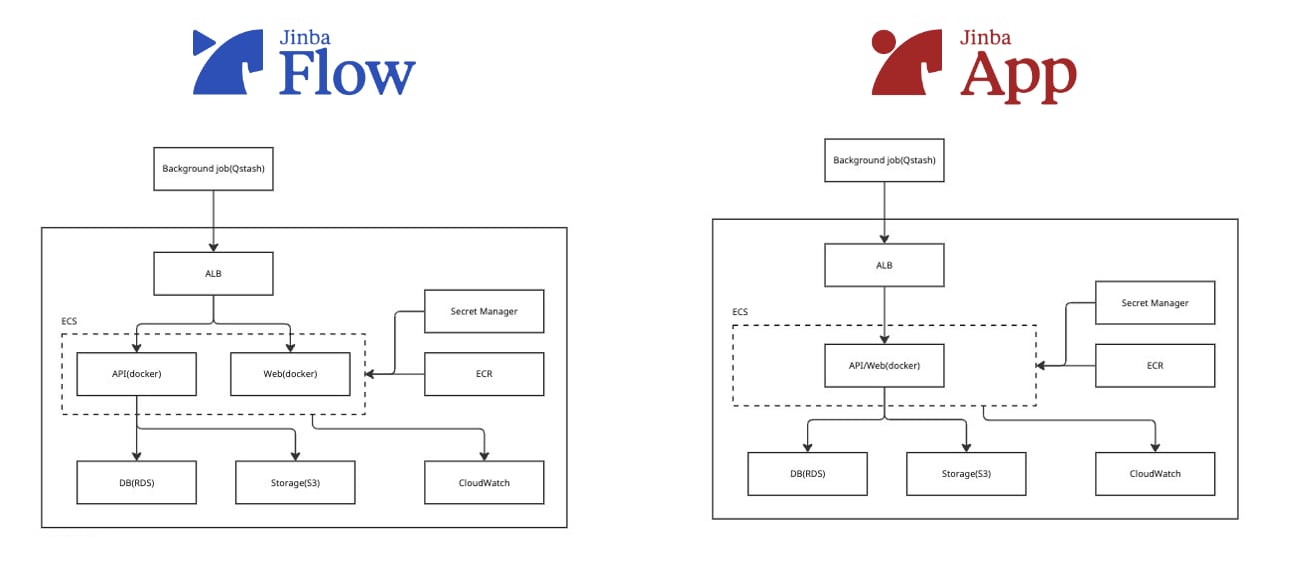
Note: This diagram shows the AWS configuration as a representative example; equivalent GCP and Azure deployments follow the same pattern. Updated August 2025.